QUALITY MANAGEMENT
Plan quality, translate requirements into measurable acceptance criteria, establish inspection and test controls, manage non-conformance, and retain traceable evidence of conformity.
Your specialist focus in this course.
Build a complete quality-management system for construction projects—from requirements and scope-based planning through inspection, measurement, non-conformance control, lifecycle integration, governance, and evidence.
WHY THIS COURSE EXISTS
Quality failures rarely begin at final inspection. They begin when requirements are unclear, acceptance criteria are subjective, control points are poorly defined, evidence is incomplete, or corrective action removes the symptom without controlling the cause.
APA–CPMP 201 develops quality as a preventive, evidence-based management system: define what conformity means, plan where it will be controlled, verify performance, correct non-conformance, and retain the evidence needed to defend acceptance.
YOUR PLACE IN THE APA–CPMP PROFESSIONAL PATHWAY
The SOC–CPMPF™ organizes Construction Project Management Practice into four Core Performance Domains and twelve Spheres of Competence. APA–CPMP 201 goes deep into SOC–CPMP 04 — Quality Management under CPD 02 — THE CONSTRAINTS OF MANAGEMENT IN FIELD OPERATIONS AND PRACTICAL COMPLETION. Within this domain, quality asks whether the work is performed correctly and can be objectively demonstrated to conform to project, contractual, statutory, technical, and client requirements.
Plan quality, translate requirements into measurable acceptance criteria, establish inspection and test controls, manage non-conformance, and retain traceable evidence of conformity.
Your specialist focus in this course.
Manage the hazards, preventive controls, supervision, monitoring, and safe systems of work required for responsible field execution.
The next CPD 02 specialist course.
Integrate environmental performance, responsible resource use, lifecycle considerations, resilience, and continual improvement into project delivery.
Completes the CPD 02 specialist sequence.
THE QUALITY MANAGEMENT CONTROL CYCLE
Construction quality is controlled through a continuous management sequence: identify what must be achieved, define how it will be verified, execute the controls, administer performance and non-conformance, then sustain quality through integration, evidence, and continuous improvement.
Identify contractual requirements, scope attributes, owner requirements, acceptance obligations, risks, and quality drivers.
Define measurable criteria, inspection points, test requirements, responsibilities, control methods, and the quality-planning basis.
Perform inspections, tests, measurements, verification, documentation, and field-quality controls against the approved requirements.
Administer NCRs, root-cause analysis, CAPA, monitoring, reporting, closure, accountability, and the evidence needed for acceptance.
Sustain quality through stakeholder integration, lifecycle governance, retained evidence, lessons learned, and continuous improvement.
HOW YOU WILL LEARN QUALITY MANAGEMENT
APA–CPMP 201 uses the BQLDM™ Four-E sequence to move from a real quality judgment, through the technical basis for control, into applied quality-management outputs and a stronger professional response.
Begin with an actual acceptance decision. Identify what evidence, requirement, tolerance, test, or contractual basis would justify accepting—or rejecting—the work.
Work through quality requirements, scope baselines, WBS/UBS control, OPR, assembly-based quality points, inspection and test planning, measurement, analytical tools, NCR, RCA, CAPA, lifecycle integration, and governance.
Develop the Quality Requirements Register, Scope-to-Quality Planning Matrix, Inspection and Test Plan, NCR/RCA/CAPA records, responsibility matrix, lifecycle control map, and the final quality-control and evidence system.
Return to the opening acceptance problem with a stronger basis for judgment: requirements, evidence, accountability, corrective action, and lifecycle quality governance.
WHAT PARTICIPANTS WILL BE ABLE TO DO
APPLIED PROFESSIONAL OUTPUTS
Each EXECUTE activity converts the quality concepts into a project-control artifact: requirements, planning, inspection, analysis, corrective control, responsibility, lifecycle integration, and retained evidence.
WHO SHOULD ATTEND

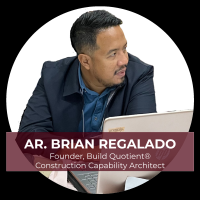
YOUR INSTRUCTOR
APA–CPMP 201 is taught from the perspective that construction quality must be defined before it can be inspected, measured before it can be controlled, and evidenced before acceptance can be defended.
The lessons connect contractual quality requirements with scope baselines, assembly control points, inspection and testing, statistical and analytical tools, NCR/RCA/CAPA, stakeholder responsibility, lifecycle governance, and retained evidence.
Quality requirements are connected to scope, assemblies, inspection points, test evidence, acceptance criteria, NCRs, corrective action, and contractual consequences.
The objective is to decide what should be accepted, rejected, corrected, escalated, documented, or improved—and to support that decision with defensible evidence.
LEARNING DELIVERY
PROFESSIONAL ENROLLMENT
₱7,999
One-time enrollment
ENROLL NOW →ENROLLMENT TERMS & CONDITIONS
These terms apply to individual enrollment in APA–CPMP 201 unless a separate written organizational or enterprise agreement expressly provides otherwise.
Enrollment provides access to the published course content for 60 days from the participant’s enrollment or activation date, unless a different access period is expressly stated for a particular program or cohort.
At the end of the access period, course access may automatically expire. Participants are responsible for completing the required learning activities within the applicable access period.
Video lessons are provided for streaming access during the enrollment period and are not downloadable unless Build Quotient expressly states otherwise. Designated non-video learning materials may be downloaded for the enrolled participant’s personal professional-learning use.
Course videos, documents, worksheets, templates, graphics, assessments, and other learning materials remain the intellectual property of Build Quotient® or the applicable rights holder. They may not be reproduced, redistributed, uploaded, resold, shared with another user, or used to deliver training without prior written permission.
Participants must complete the required lessons, knowledge checks, EXECUTE activities, assessments, and other completion requirements prescribed for APA–CPMP 201.
Submission of an activity does not by itself establish professional competency. Where professional judgment or applied evidence is required, participants may be required to explain or defend the basis of their work.
Where live online participation forms part of the published program, participants are responsible for attending the scheduled sessions. For APA–CPMP 201, the published live online dates are Decrmber 9–10, 2026.
Advance access to asynchronous course content does not automatically substitute for required live participation where attendance or guided participation forms part of the completion requirements.
Certificates are issued only after successful completion of the applicable course requirements.
Any CPD credit, CMDF recognition, or other external recognition is subject to the requirements, rules, and continuing validity of the relevant accrediting, regulatory, professional, or institutional body. Course completion does not by itself constitute a separate occupational competency credential unless expressly stated.
Submitted work must substantially represent the participant’s own professional analysis and application. Plagiarism, falsification of evidence, misrepresentation of another person’s work, unauthorized collaboration, or unauthorized sharing of assessment answers may result in rejection of the submission, withholding of completion recognition, or removal from the program.
Individual enrollment is licensed for use by one registered participant only. Login credentials and course access may not be shared.
Build Quotient® course content, proprietary frameworks, templates, learning materials, and instructional resources may not be copied, reproduced, adapted, published, distributed, resold, sublicensed, or used to conduct another training program without written authorization.
Enrollment is confirmed only after successful payment or an approved organizational enrollment arrangement. Payment methods available at checkout may vary depending on the payment provider and transaction location.
Participants are responsible for any charges imposed by their own bank, card issuer, payment provider, foreign-exchange provider, or other third party that are not included in the published course fee.
Course enrollment is a commitment to a defined professional learning program. Refunds are not offered on the basis of dissatisfaction, change of mind, inability to attend, failure to complete the course, or a participant’s personal assessment that the course did not meet expectations.
A refund may be considered where Build Quotient is unable to deliver the enrolled program substantially as published, including circumstances such as:
Where a scheduled live session must be moved, Build Quotient may first offer a rescheduled session, replacement cohort, transfer, or other reasonable delivery arrangement. A schedule change by itself does not automatically create a refund entitlement where the program can still be substantially delivered.
Refund requests based solely on a participant’s change of circumstances, scheduling conflict, non-attendance, failure to complete required activities, dissatisfaction with teaching style, or decision not to continue are not refundable.
Any refund due because of non-delivery will be limited to the amount actually paid for the affected enrollment and will be processed in accordance with the original payment method and applicable payment-provider requirements.
Nothing in these Terms is intended to limit any consumer right or remedy that cannot lawfully be excluded under applicable Philippine law.
At Build Quotient’s discretion, a participant who cannot continue with the originally scheduled program may be permitted to transfer to a later available cohort of the same course. Transfers are subject to availability, applicable deadlines, and any administrative conditions published for the program.
A transfer is a discretionary enrollment accommodation and is not equivalent to a refund.
Enrollment information may be used to administer the course, provide access, communicate schedules and requirements, issue certificates, maintain learning and completion records, and provide applicable professional-development documentation in accordance with Build Quotient’s applicable privacy policy.
Bulk, enterprise, corporate, institutional, or sponsored enrollments may be governed by separate written commercial, billing, access, transfer, reporting, or delivery terms. Where such terms are formally agreed in writing, those provisions will apply to the extent they differ from these individual enrollment terms.
FREQUENTLY ASKED QUESTIONS
The course develops quality management as a complete construction project-control system. It begins with the contractual and performance basis of quality, then moves into scope-based planning, inspection and test controls, measurement and analytical tools, non-conformance and corrective control, stakeholder integration, lifecycle quality, and project quality governance and evidence.
UOC 01 examines the relationship of quality to scope, cost, and time, while UOC 02 uses scope baselines, work breakdown structures, unified breakdown structures, OPR and performance requirements, and assembly-based quality control points to turn approved scope into a measurable quality-planning framework.
Yes. UOC 03 covers quality measurement, types of quality-control systems, and inspection and test planning. Its EXECUTE activity requires you to develop an Assembly Inspection and Test Plan tied to defined project requirements and control points.
Yes. UOC 04 covers Statistical Process Control in construction and the Seven Basic Quality Tools. You will use quality data to determine an appropriate control response rather than simply collecting inspection results.
Yes. UOC 05 covers non-conformance reporting systems, root cause analysis, CAPA, quality risk exposure, monitoring and reporting systems, and quality-control mechanisms. The EXECUTE activity requires you to process the NCR, RCA, CAPA, and closure.
UOC 06 focuses on quality-management integration, stakeholder engagement, and continuous improvement. You will develop a Quality Integration and Responsibility Matrix that clarifies who is responsible for quality decisions, controls, evidence, and improvement.
Yes. UOC 07 applies quality management across predesign, design, procurement, and construction. UOC 08 continues into post-construction quality governance and systems for quality management, culminating in a Project Quality Control and Evidence System.
You will develop eight applied outputs: the Quality Requirements Register; Scope-to-Quality Planning Matrix; Assembly Inspection and Test Plan; Quality Data Analysis and Control Response; NCR/RCA/CAPA and Closure Record; Quality Integration and Responsibility Matrix; Lifecycle Quality Control Map; and the Project Quality Control and Evidence System.
NEED ASSISTANCE?
Choose the most convenient way to reach Build Quotient.
ENROLLMENT NOW OPEN
Develop the ability to define quality requirements, plan verification, inspect and measure performance, control non-conformance, integrate responsibility, and retain defensible evidence—while positioning Quality Management within the wider APA–CPMP professional pathway.
Develops practical competence in quality planning, verification, inspection, corrective control, and quality governance to ensure that constructed work conforms to defined project and contractual requirements. The original module emphasizes defect prevention, minimized rework, accountability, and lifecycle quality governance.

Special Access CMDF QAQC Participants from NHA